
U Type Evaporator
U Type Evaporator

Flooded Evaporator
Flooded Evaporator

Oil Cooler
Oil Cooler Heat Exchanger


Condenser
Condenser Heat Exchangers
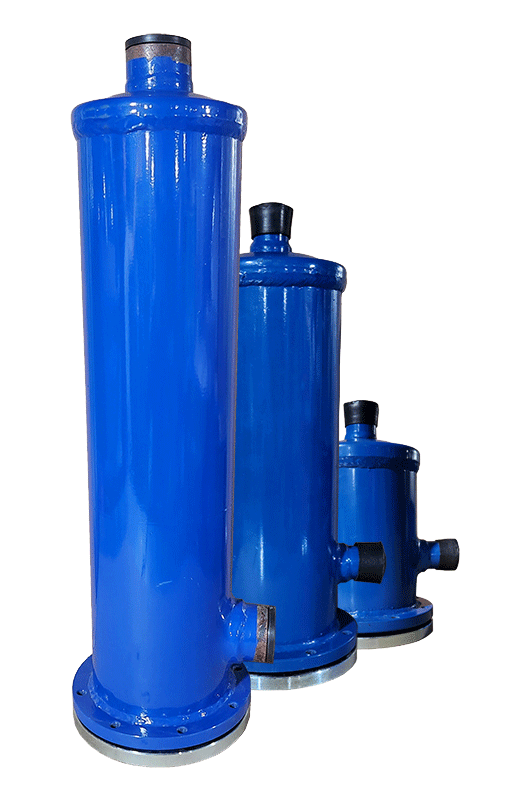
Filter Driers
Filter driers



In this type of heat exchanger, a higher heat transfer surface is generated by circulating water around or inside the tubes, while the hydraulic fluid flows in the opposite space. The above image shows a water-cooled shell and tube oil cooler. The use of shell and tube heat exchangers has been common in industry for over 50 years, and with the gradual increase in heat transfer surface and reduction in overall dimensions and length, their manufacturing costs have decreased.
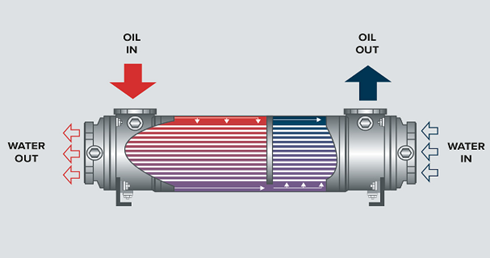
In this type of heat exchanger, the cooling process is carried out by circulating the hydraulic fluid around the tubes carrying the coolant (water). It should be noted that as the coolant passes through the inside of the tube, the inner surface gradually becomes fouled and acts as an insulator. By using mechanical or chemical methods, excess deposits can be removed and the efficiency of the oil cooler can be increased. The amount of heat transfer required to reach the desired temperature in a hydraulic system can be calculated using various methods.
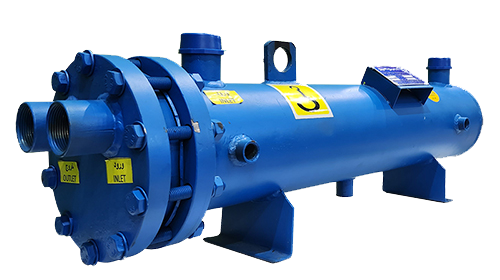
The hydraulic oil used in industries needs to be maintained at a suitable operating temperature, and any increase or decrease in temperature can damage its operation. Hydraulic oil undergoes an increase in temperature due to these processes and loses its important physical properties, including its lubricating properties. Given that the oil temperature should not exceed 60 degrees Celsius or 140 degrees Fahrenheit, an increase in temperature beyond the specified values can cause oxidation of the oil and reduce its viscosity. This factor damages the components that are in constant contact with the oil and adds a significant cost to the system in addition to the cost of losing the oil. It is necessary to install a device called an oil cooler in the oil path.
Material:
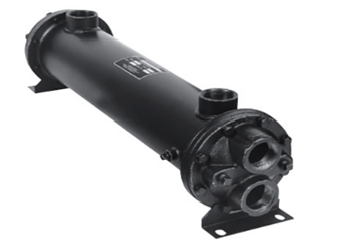
The material of shell and tube heat exchangers depends on the type of fluid and the corrosiveness of the flowing fluid. The body is usually made of carbon steel, stainless steel, or brass, and the inner tubes are usually made of copper, stainless steel, carbon steel, brass, etc. Its operation is such that energy and heat are transferred from the hot fluid to the tube walls (inner tubes) and from the other side, this heat is transferred to the cold fluid.
Applications:
This type of heat exchanger is used in various industries, including:


Advantages:
Cooling hydraulic oil is essential for reducing industrial costs.
Increasing the lifespan and optimal performance of industrial components and equipment, improving system performance by using oil, and increasing the optimal lifespan of oil are the most important advantages of hydraulic oil coolers.
Asamobadel Caspian has had successful experiences in cooling various processes in different industries, including:

By using the best engineering and commercial software and having the specifications of the cooled fluid such as heat transfer coefficients, viscosity, and thermodynamic properties of the fluid in question, as well as the desired temperature range, Asamobadel Caspian can design the desired exchanger for its customers and offer the best possible proposal based on the installation space and operating conditions of the device.


 فارسی
فارسی